about badger boards.
Badger Boards is one person in Texas, designing small open-source circuit boards and building them at home. The files to make your own are published next to each board.
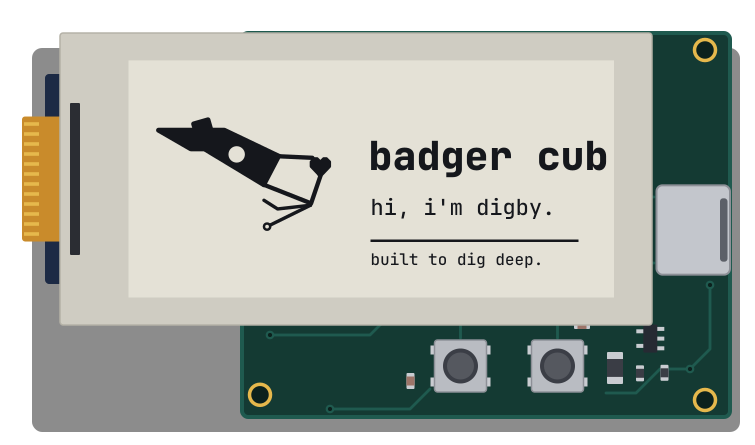
The first one is the Badger Cub, an e-ink keychain. Every board after it follows the same three principles, listed below.
digby's status
nothing here needs an account. once it's in your hands, it's yours.
studio datasheet
- studio
- badger boards
- based in
- texas
- headcount
- 1 human, 1 badger
- hardware license
- CERN-OHL-S-2.0
- default mcu
- RP2040
- firmware
- bare-metal rust
- first board
- badger cub
- contact
- [email protected]
why badger boards?
§01A lot of small gadgets only work through a companion app, and quit when the app stops getting updates. That felt like the wrong way to build something you carry around every day.
Badger Boards makes the other kind: boards that ship with their source files and keep working with nobody else involved.
It's a one-person shop, so batches are small and slow. The upside is that every board goes through the same pair of hands before it ships.
principles
§02p-01
hardware you actually own
The KiCad project and BOM for every board are published under CERN-OHL-S v2. No board needs a cloud account or a mandatory app to work.
If this studio disappeared tomorrow, you'd still have the files to build your own or repair the one you have.
- hardware license
- CERN-OHL-S-2.0
- published per board
- KiCad project, BOM, firmware source
- account required
- none
- companion app
- none
p-02
built for sunlight and longevity
Where a board has a screen, it is e-ink. It reflects light instead of emitting it, so it reads best in direct sun and keeps its image with the power off.
Firmware is bare-metal Rust on the RP2040. There's no operating system underneath, which leaves less code to break and less to keep patched.
- power to hold an image
- 0 W
- mcu
- RP2040, dual Cortex-M0+ @ 133 MHz
- firmware
- bare-metal Rust, no OS
- reflashing
- USB, RP2040 ROM bootloader
p-03
small-batch texas engineering
Boards are laid out and assembled in-house in Texas, a small run at a time.
Small runs mean less dead stock sitting in a warehouse and fewer boards ending up as e-waste. When a batch sells out, the next one gets built.
- location
- texas
- assembly
- in-house reflow
- production
- small batches, not mass runs
- packing
- by hand
how we build
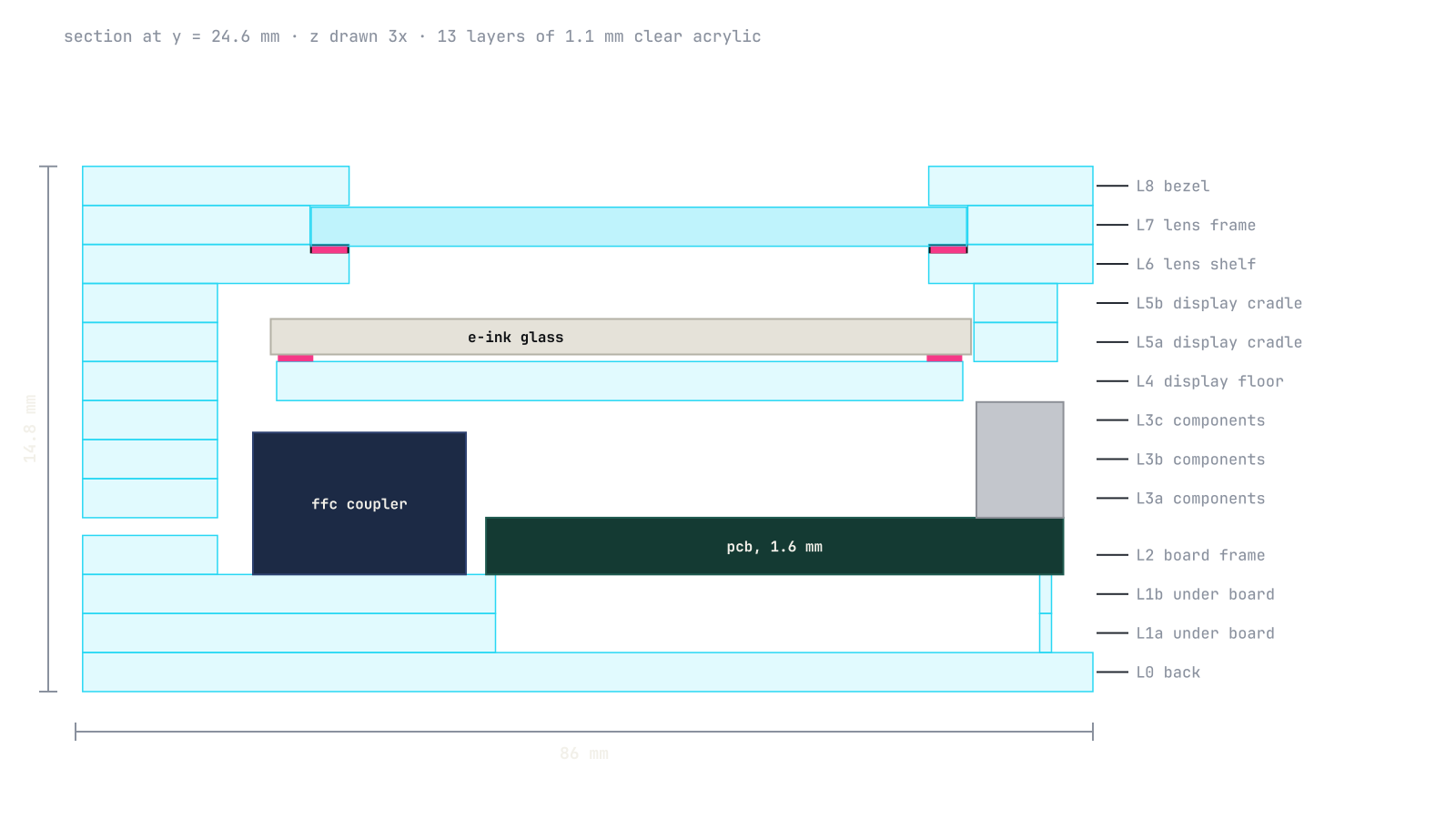
§03Every board takes the same path from KiCad to your pocket. Only the bare circuit boards come from outside; the rest happens on one bench.
| step | stage | what happens | output |
|---|---|---|---|
| 01 | design | Schematic and layout in KiCad. The project goes public with the board. | KiCad project |
| 02 | panelize | Boards are stepped into a panel with rails, so a whole batch is pasted and reflowed in one pass. | panel gerbers |
| 03 | fab | Bare panels come from a PCB fab. Everything after this happens on the bench here. | bare panels |
| 04 | paste & place | Solder paste through a stencil, then parts onto their pads. | populated panel |
| 05 | reflow | In-house reflow, one panel at a time. | soldered panel |
| 06 | flash & test | Rust firmware goes on over USB, and every board is powered up and checked before it moves on. | working board |
| 07 | depanel & pack | Boards are snapped out of the panel, cased where the design calls for it, and packed by hand. | your board |
what's open, and what isn't
§04open · CERN-OHL-S-2.0
the designs
- Build boards from the files, for yourself or to sell.
- Change the design however you like.
- If you distribute a modified design, publish your changes under the same license. That's the "S" (strongly reciprocal) part.
Firmware licenses are listed in each firmware repository.
not open · trademarks
the names and the badger
The names Badger Boards and Badger Cub, the logo and Digby himself aren't covered by the hardware license.
- Selling your own build? Take the logo off the silkscreen, and don't call it a Badger Boards product.
- "Based on the Badger Cub" with a link back is fine, and appreciated.
A plain-English summary, not legal advice. The CERN-OHL-S v2 text is what counts.